Decision Discipline & Control Surface
The Model
Decision discipline is not personality or intuition. It is a set of cognitive operations that can be modeled, externalized, and supported by structured tooling.
Proposal and commitment
At its core, Helm separates exploration from commitment.
Rather than forcing early decisions, the system:
- explores multiple possible directions in parallel
- produces concrete artifacts for each
- defers commitment until sufficient context exists
Discipline emerges not from choosing quickly, but from maintaining optionality without cognitive overload.
This structure allows Helm to:
- explore broadly when uncertainty is high
- narrow focus as clarity increases
- revisit earlier decisions when assumptions change
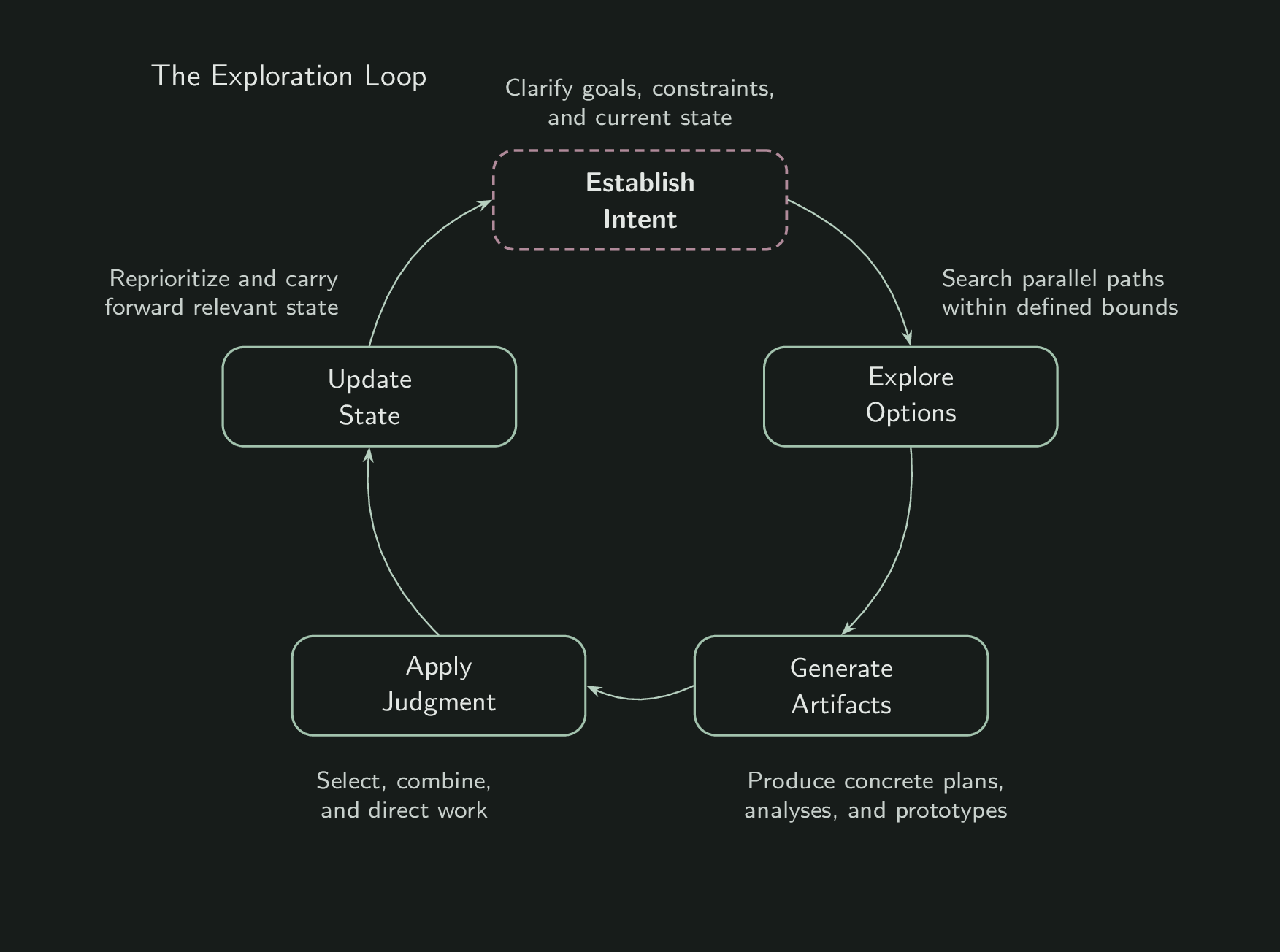
The exploration loop
Helm operates in a continuous loop:
- Context & Intent
- Structured Exploration
- Artifact Generation
- Human Promotion & Input
- Retention as Context
Proposals accumulate; humans review and apply when ready.
The system advances exploration without forcing premature convergence or silent state changes.
Proposal intensity as a spectrum
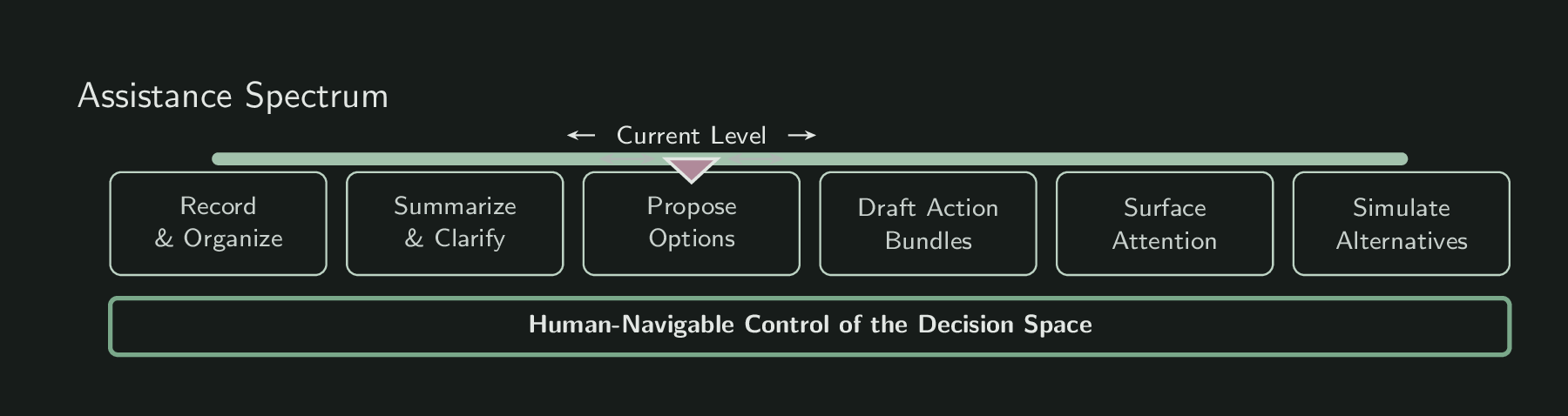
Structuring assistance in Helm is not binary.
It operates along a controllable spectrum of proposal intensity.
- Minimal: record and organize
- Moderate: surface connections, suggest structure
- Active: generate proposals, draft artifacts
The level of structuring adapts to:
- task complexity
- confidence in direction
- desired review granularity
Crucially, proposal intensity is visible and adjustable, not hidden or assumed.
Decisions as a causal graph
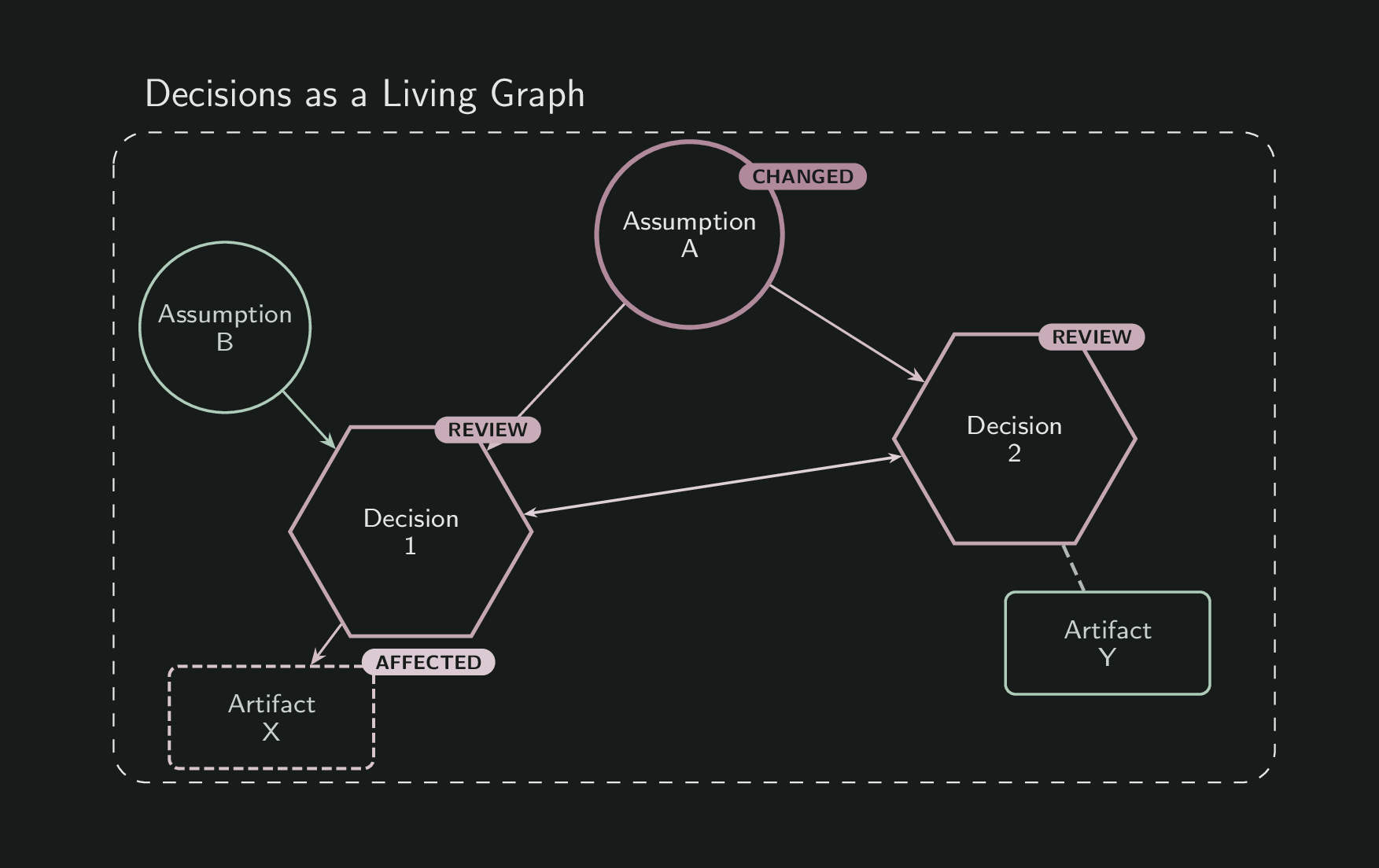
Helm treats decisions as nodes in a living causal graph.
Each decision is linked to:
- the assumptions it depends on
- the work it influences
- related explorations and downstream effects
When assumptions change, Helm can identify which decisions and artifacts may be affected and surface them for review.
Helm does not automatically rewrite reality.
It makes causal structure visible so humans can intervene intelligently.
Maintaining cognitive structure
Humans are not bad at thinking. They are bad at maintaining complex mental structures over time.
Helm is designed to externalize and maintain:
- evolving intent
- decision context
- branching possibilities
- deferred work
- partial conclusions
By maintaining these structures, Helm reduces:
- cognitive load
- context loss
- decision fatigue
- unnecessary rework
This allows human effort to be spent where it matters most: judgment, creativity, and direction.
Transparency and reversibility
Every action Helm takes is:
- inspectable
- attributable
- reversible
Exploration does not require commitment.
Application does not imply permanence.
Decisions can be revisited.
This is not a safety feature added later. It is foundational to the model.
What Helm is not
Helm is not a black box.
It is not an opaque optimizer.
It does not silently override human intent.
Decision discipline in Helm is explicit, adjustable, and accountable.
Summary
Helm models decision discipline as a dynamic, inspectable process rather than intuition or habit.
By combining structured exploration, reversible decisions, and adjustable proposal intensity, it enables humans to operate coherently across long-horizon work — without losing clarity or control.